Showing posts with label commute. Show all posts

Wednesday, November 28, 2012

De-squealing brakes

Its the season for howling brakes.  I thought I would share my understanding of the problem and see if anyone has thoughts to share.  A little squeal is okay, but if you see pedestrians cringing when you stop at an intersection or you find yourself avoiding the front brake to save your eardrums- time to solve the problem.  Although it can be nice to announce hard braking required when a car pulls in front of you...
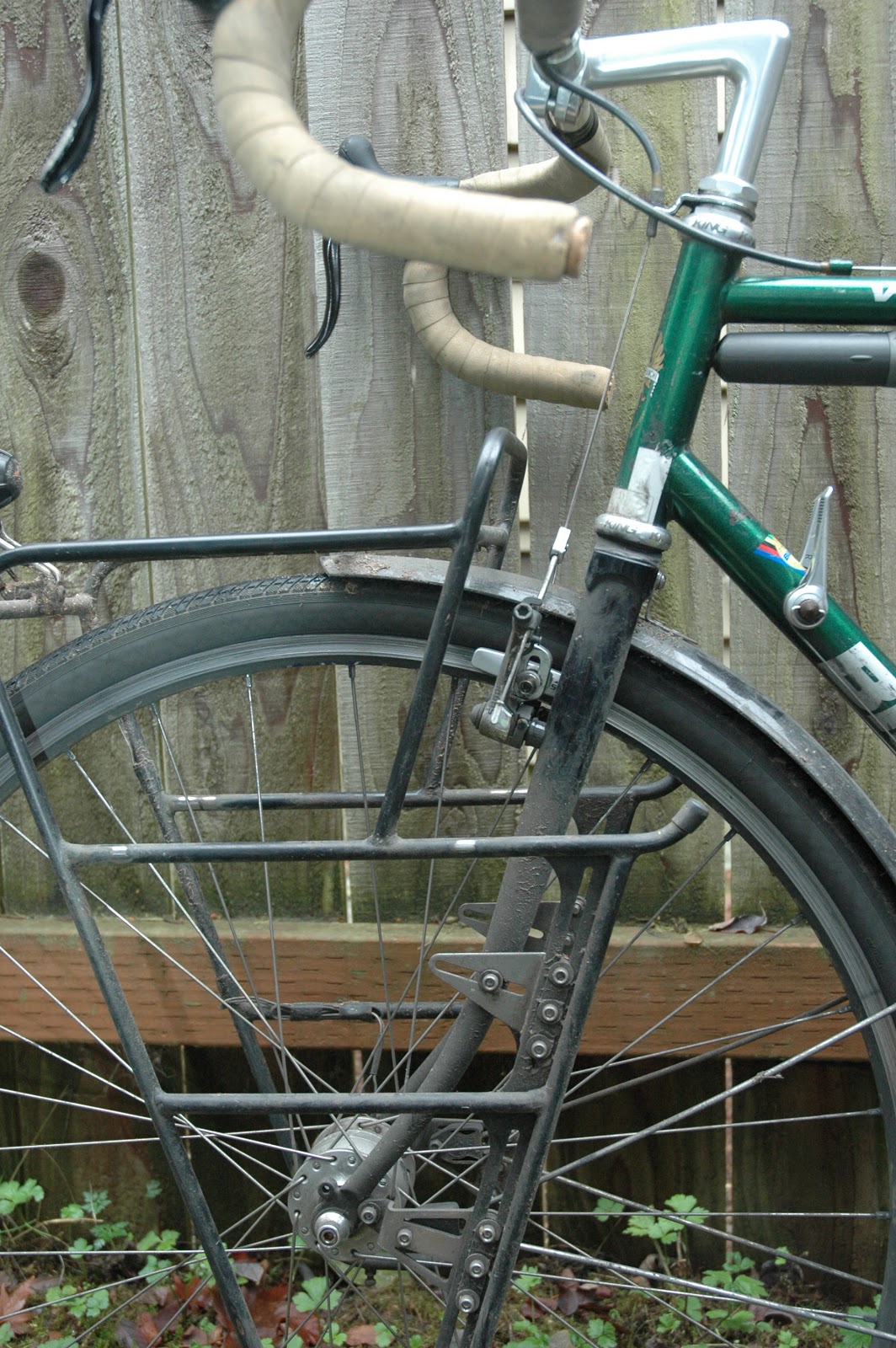
A shudder or squeal occurs when the brake momentarily locks up and then releases the rim.  If this happens at a low frequency, shudder occurs.  At a higher frequency it is a squeal.  I think of it as being similar to a shimmy:  it is a resonant frequency that can be caused by many small things.  So there is not one universal fix. The main contributor is a bow string effect of the brake cable.  The longer the bowstring, the worse the shudder and squeal.  When the brake is applied, the fork deflects backwards.  This draws the cable tighter, like a bow string.  Which causes the brake to momentarily but suddenly lock the rim.  It does not happen as much on the rear brake because the frame doesn't move in response to braking as the fork does.  Also doesn't happen as much with sidepull  or V brakes because there is no bowstring- the cable attaches directly to the brake.
If you look closely at my commuter here (with the squeal issues) the cable stop is at the usual place on the headset.  That leaves about 12 inches of bowstring.  I solved the problem of brake shudder on my cyclocross bike with a fork crown mounted cable stop.  That leaves about 1.5 inches of bowstring, and totally eliminated brake shudder.  I've had the same results on other bikes.  The fork crown on this bike, which I had R&E cycles make after the demise of the stock fork, doesn't have a hole in the fork crown so its not an option.  I didn't think to specify that when I had the fork built because I assumed that any steel fork aside from maybe a track fork would have a hole.  I was wrong.  Its otherwise a great fork.

Frictional qualities between the rim and brake pad can also cause squeal and shudder.  A new rim can be quite grabby at first, until the surface gets worn in a little.  Tubular glue on the rim surface can cause squealing.  The brake pad material can make a big difference.  In my experience, salmon brake pads squeal less, brake much better in wet conditions, and don't wear the rims out quite as fast as black compounds.  Sometimes taking a brillo pad or sandpaper to the rim and brake pad can eliminate squealing.  In this case the brake pads were getting thin so I replaced them (Yokozuna salmon pads) and the problem is solved.

Finally, its possible that laxity where the brake pivots on the cantilever post or in the parallelogram linkage on V brakes may facilitate squealing.

The amount of fore/aft movement of the fork under braking influences shudder and squeal, as described above.  A properly designed fork can help eliminate the shudder.  Modern cyclocross carbon forks have gone to truly massive fork crowns and oversize lower headset bearings to minimize flex between the cantilever posts and cable stop.  It seems to me that a fork crown mounted cable stop is an easier, lighter, and more elegant solution.  For a steel fork- the fork blades should be oval in cross section at the crown and taper down below the cantilever posts to a nice small radius bend near the dropouts.  This makes it so that fore/aft flexion occurs mostly below the cantilever posts where it won't create the bow string effect.  This also makes it so that more up/down flexing occurs over bumpy terrain, improving ride quality.  The current trend of making straight-bladed steel forks bugs me!  Its done either to mimic carbon forks or save labor, but there is no functional reason for it that I am aware of.

A word on discs, because I know what you're all thinking...  I know, hydraulic discs are awesome.  I have used them.  They belong on suspension bikes because they have unsurpassed power and modulation.  I don't have my own yet but someday I will.  Hydraulic discs are overkill on a road racing bike or cyclocross racing bike.  But on a cargo, commuter, or mountain bike its probably worth the added weight and complexity for the truly awesome braking power.  Going down a steep hill in a rainstorm with a trailer?  I've done that many times, and you have to be really careful!

I'm not sold on cable actuated disc brakes. They have the same drawbacks as hydraulic discs in terms of weight and complexity but aren't as powerful because of cable flex. The pads have to sit really close to the rotor so they are more prone to brake rub if the rotors are warped. Cantilevers are maligned as much as they are because of tricky setup.  A properly set up cantilever is just as powerful, or nearly so, compared to a cable disc.  A poorly set up cantilever is admittedly awful.  No power, poor modulation, and noisy.  The most common pitfalls are a straddle cable that is too high, resulting in no power, or crappy pads.  I don't even bother with the stock black pads anymore.  They are immediately replaced with salmon pads.

So before you toss your cantilevers in the garbage, tinker with them a little.  Lower the straddle cable and change the pads.  You might be surprised.


Tuesday, September 25, 2012

what is your bike made out of?


This one is made of steel.  On my home home from work I made a bonehead move- a left hand turn into an oncoming car.  No idea why I didn't see it.  I've been riding to and from work most days for 10 years.  I hit the front of the car at an angle, went over the bars, bounced off the windshield and landed on my feet.  I completely caved  in the windshield and don't even have a bruise myself. Really stupid and really lucky.  The visibly shaken but nice woman in the car that I hit and I had a short but pleasant conversation and exchanged information.  I put the wheel back in the skewed fork and rode home, slowly.
 Try that with a carbon fork.  I'm afraid the fork is beyond help this time but I had the people at Elliott Bay straighten it from a crash several years ago. Right now there is a trend for even steel frames to use a carbon fork.  I would rather ride a carbon frame with a steel fork.  A frame is a nice strong triangle and less likely to fail, and even if it does you can probably land safely.  If, on the other hand, a steerer tube or fork leg snaps while you are riding- and we all know that it happens- you are going to hit the ground hard.
Other benefits of a properly designed steel fork, aside from reliability, in my opinion, are better ride quality and better clearance for mud/fenders/bigger tires.  Its probably true that carbon transmits less road vibration and has a nice damp feel to it.  The straight legs on carbon forks are really stiff vertically.  A steel fork with the offset in a nice round bend near the dropouts, like this Colorado II fork, is much more comfortable.  If anyone has an orphaned Serotta Colorado fork with 9 inches of steerer let me know!

Saturday, January 29, 2011

Bicycle licenses?

I've been hearing a lot of buzz lately in the Seattle Times and other places about how bicycles should be licensed. The bike haters generally say: cyclists flout traffic laws and don't pay taxes, and yet we spend all this tax money on bike infrastructure. Here are the problems with that argument. I apologize to the cyclists that have heard all this before and to whom I'm preaching to the choir.

1. I'm a law abiding citizen and these bikers don't follow traffic laws. All right, so you always drive the speed limit, always come to a complete stop at stop signs, always give me my 3 feet when passing? I'll bet! I drive sometimes too and readily admit that I bend traffic laws while driving. Saying that only cyclists flout traffic laws is like saying that only poor people rob people. The truth is they just rob you differently. Likewise people will bend traffic laws and convenience and enforcement allows. Rolling through a stop sign or proceeding through a red light in a vehicle are poor form for sure- but on a bike not as much. Many traffic lights won't detect bicycles so if you are at a light by yourself you'll be waiting a while for that green light. Cyclists have vastly better hearing and visibility and generally approach intersections slower than cars do, so it is possible to safely proceed through a red light when it wouldn't be in a car. I'm not talking about bombing through red lights, just rolling through them after stopping or at least being 100% certain that the intersection is clear. Similarly cars often travel above the speed limit because it is reasonably safe to do so. Bikes are not usually going to be exceeding the speed limit and if they are bikes will still be slower than the average flow of vehicle traffic. So in general, we all bend traffic rules but in different ways. The main difference is that if someone screws up behind the wheel of a 4000 lb vehicle, someone besides the driver will get hurt. A cyclist is only going to hurt him or herself.

2. I pay taxes for roads and these freeloader cyclists don't. This is straight out of the republican playbook of repeating a lie often enough that eventually everyone believes it. The truth is that gas taxes pay for a part of interstate highways (that cyclists generally don't use). Other road and infrastructure improvements come from the general tax fund that we all contribute to. Yes, thats right, cyclists pay taxes too! All these years of paying taxes, I have never encountered a cyclist specific tax bracket. If there is one that will get me out of paying taxes, please let me know at once! There are other important points here. One being that cycling specific intrastructure doesn't cost that much. The biggest projects I see are multi use trails such as the Burke Gilman. Cyclists use these but so do walkers, joggers, rollerbladers, dogs, etc. Car owners benefit from these trails as much as cyclists do. Personally, I only use these trails when I need to avoid roads that are overly dangerous for cyclists. Cycling specific improvements are limited to restriping lanes, painting sharrows, and the odd sign. Which has to be really cheap compared to repaving and building new roads. This leads to a second point: wear and tear on roads. It is directly related to vehicle weight, other factors such as water/ice/snow being equal for bikes and cars. Except studded tires that people use from November to April for that one day of snow, but I digress. Bikes don't weigh anything compared to cars so they don't contribute much to wear and tear on roads. The final point on taxes: a regular bicycle commuter is not contributing as much carbon and pollution to the air and is not getting sick as much, all other factors being equal. Pollution and hospital bills have a big impact on the tax situation. I pay 400 dollars a month on health insurance. I don't have a doctor because I never get sick. I have never taken a sick day off from work in my life. I have to think that it is at least partially due to the regular exercise I get from commuting by bicycle.

3. I don't care about the previous arguments, I still want bicycles to be licensed and add one more hurdle for would- be bicycle commuters. Because bicycle hating motorists, huge potholes, rain, and roads designed almost exclusively for cars aren't enough. Fine. I have a 2004 Suburu and the yearly licensing fees are about 100 bucks. It weighs 3800 pounds. The fair way to do this is by vehicle weight. My heaviest bike, a Bianchi Volpe, weighs maybe 30 pounds. That works out to 78 cents. I'll pony up my 78 cents if I have to. I don't think it would begin to cover the administrative costs though.

Thursday, May 13, 2010

spring is here

Living in Seattle, where you often don't see the sun for months at a time in the winter, the first nice days of spring are extra special. Even if the rest of the day was lousy, if the sun is out you automatically feel 100 percent better. I think Tuesday was such a day- My morning commute was typical but on the way home in the blazing sunshine, everyone was out riding their bike. And everyone was smiling and waving at each other. And not just people- I had to dodge more squirrels and crows than usual and even a raccoon in the morning. The level of hormones in the air just doubled. Happy spring!

Sunday, May 2, 2010

Bellevue is wrong

Just read in the Seattle Times this morning that Kemper Freeman, the landlord of downtown Bellevue, is spending millions of his own dollars to sue the state to prevent light rail on I-90. If he succeeds he will doom light rail on 520 too. He would rather see more auto lanes on the areas freeways. The current plan for the new 520 bridge calls for more lanes that directly connect to I-5 heading west, while there would still be single lane ramps for the ramps heading east on 520 from Seattle. McGinn's plan would change this and also calls for light rail on 520- predictably, the east side contingent are howling.

The crux of this issue is that transportation -wise, whatever you build will be used. You could build a 10 lane I-90 and I-405 and there would still be single occupancy vehicle gridlock. Or you could build light rail and infrastructure for mass transit and cycling- it would be used, there would be less traffic and less pollution, and most importantly everyone would have more than one reasonable choice for how to commute. Right now most people drive because even with traffic, it winds up being faster than taking the bus or riding a bike. And riding a bike is still downright dangerous in some places. I commute from the wedgwood neighborhood of Seattle to Eastgate in Bellevue by bike. Everything is fine until you get to Eastgate (the Montlake interchange from the last post is weird but doable once you figure it out). Riding eastbound on Eastgate and hanging a left on 156th is daunting- you have to merge into multiple lanes of high speed traffic- only a bicycle fanatic would do it on a regular basis. This is a good example of an area where a car is the only reasonable option for most people. There are lots of roads on the eastside that are like this. If I want to ride somewhere in Seattle, I just ride in the general direction of where I want to go and I'll get there in one piece. If I want to ride somewhere on the eastside, I pore over the bicycle map and carefully plan the route that is least suicidal, and if you get off track you will find yourself on a dangerous road. I think that is why I see tons of other cyclists on my commute in Seattle and Mercer Island and then hardly anybody once I'm in Bellevue.

Areas that allow more than one mode of transportation are more liveable and more pleasant. It is isolating and depressing to have to live somewhere where you are required to get in a car if you want to go to work, school, the grocery store or whatever. I'm sorry to say eastsiders, but if you continue to be developed around the automobile you will always be the ugly stepchild of Seattle that you are now.