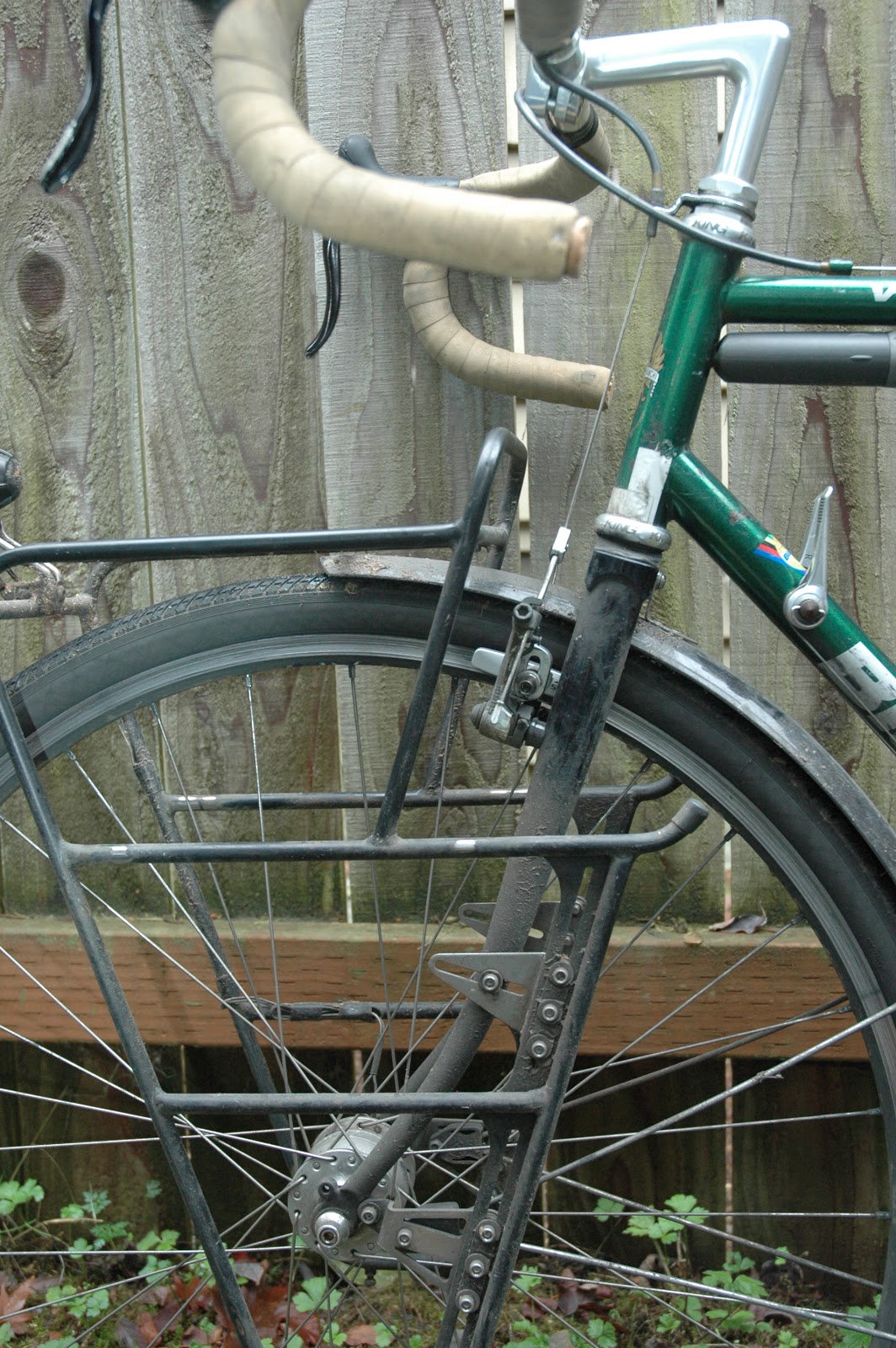
Its the season for howling brakes. I thought I would share my understanding of the problem and see if anyone has thoughts to share. A little squeal is okay, but if you see pedestrians cringing when you stop at an intersection or you find yourself avoiding the front brake to save your eardrums- time to solve the problem. Although it can be nice to announce hard braking required when a car pulls in front of you...
A shudder or squeal occurs when the brake momentarily locks up and then releases the rim. If this happens at a low frequency, shudder occurs. At a higher frequency it is a squeal. I think of it as being similar to a shimmy: it is a resonant frequency that can be caused by many small things. So there is not one universal fix. The main contributor is a bow string effect of the brake cable. The longer the bowstring, the worse the shudder and squeal. When the brake is applied, the fork deflects backwards. This draws the cable tighter, like a bow string. Which causes the brake to momentarily but suddenly lock the rim. It does not happen as much on the rear brake because the frame doesn't move in response to braking as the fork does. Also doesn't happen as much with sidepull or V brakes because there is no bowstring- the cable attaches directly to the brake.
If you look closely at my commuter here (with the squeal issues) the cable stop is at the usual place on the headset. That leaves about 12 inches of bowstring. I solved the problem of brake shudder on my cyclocross bike with a fork crown mounted cable stop. That leaves about 1.5 inches of bowstring, and totally eliminated brake shudder. I've had the same results on other bikes. The fork crown on this bike, which I had R&E cycles make after the demise of the stock fork, doesn't have a hole in the fork crown so its not an option. I didn't think to specify that when I had the fork built because I assumed that any steel fork aside from maybe a track fork would have a hole. I was wrong. Its otherwise a great fork.
Frictional qualities between the rim and brake pad can also cause squeal and shudder. A new rim can be quite grabby at first, until the surface gets worn in a little. Tubular glue on the rim surface can cause squealing. The brake pad material can make a big difference. In my experience, salmon brake pads squeal less, brake much better in wet conditions, and don't wear the rims out quite as fast as black compounds. Sometimes taking a brillo pad or sandpaper to the rim and brake pad can eliminate squealing. In this case the brake pads were getting thin so I replaced them (Yokozuna salmon pads) and the problem is solved.
Finally, its possible that laxity where the brake pivots on the cantilever post or in the parallelogram linkage on V brakes may facilitate squealing.
The amount of fore/aft movement of the fork under braking influences shudder and squeal, as described above. A properly designed fork can help eliminate the shudder. Modern cyclocross carbon forks have gone to truly massive fork crowns and oversize lower headset bearings to minimize flex between the cantilever posts and cable stop. It seems to me that a fork crown mounted cable stop is an easier, lighter, and more elegant solution. For a steel fork- the fork blades should be oval in cross section at the crown and taper down below the cantilever posts to a nice small radius bend near the dropouts. This makes it so that fore/aft flexion occurs mostly below the cantilever posts where it won't create the bow string effect. This also makes it so that more up/down flexing occurs over bumpy terrain, improving ride quality. The current trend of making straight-bladed steel forks bugs me! Its done either to mimic carbon forks or save labor, but there is no functional reason for it that I am aware of.
A word on discs, because I know what you're all thinking... I know, hydraulic discs are awesome. I have used them. They belong on suspension bikes because they have unsurpassed power and modulation. I don't have my own yet but someday I will. Hydraulic discs are overkill on a road racing bike or cyclocross racing bike. But on a cargo, commuter, or mountain bike its probably worth the added weight and complexity for the truly awesome braking power. Going down a steep hill in a rainstorm with a trailer? I've done that many times, and you have to be really careful!
I'm not sold on cable actuated disc brakes. They have the same drawbacks as hydraulic discs in terms of weight and complexity but aren't as powerful because of cable flex. The pads have to sit really close to the rotor so they are more prone to brake rub if the rotors are warped. Cantilevers are maligned as much as they are because of tricky setup. A properly set up cantilever is just as powerful, or nearly so, compared to a cable disc. A poorly set up cantilever is admittedly awful. No power, poor modulation, and noisy. The most common pitfalls are a straddle cable that is too high, resulting in no power, or crappy pads. I don't even bother with the stock black pads anymore. They are immediately replaced with salmon pads.
So before you toss your cantilevers in the garbage, tinker with them a little. Lower the straddle cable and change the pads. You might be surprised.
Showing posts with label retrogrouchery. Show all posts
Wednesday, November 28, 2012
Tuesday, September 25, 2012
what is your bike made out of?
This one is made of steel. On my home home from work I made a bonehead move- a left hand turn into an oncoming car. No idea why I didn't see it. I've been riding to and from work most days for 10 years. I hit the front of the car at an angle, went over the bars, bounced off the windshield and landed on my feet. I completely caved in the windshield and don't even have a bruise myself. Really stupid and really lucky. The visibly shaken but nice woman in the car that I hit and I had a short but pleasant conversation and exchanged information. I put the wheel back in the skewed fork and rode home, slowly.
Try that with a carbon fork. I'm afraid the fork is beyond help this time but I had the people at Elliott Bay straighten it from a crash several years ago. Right now there is a trend for even steel frames to use a carbon fork. I would rather ride a carbon frame with a steel fork. A frame is a nice strong triangle and less likely to fail, and even if it does you can probably land safely. If, on the other hand, a steerer tube or fork leg snaps while you are riding- and we all know that it happens- you are going to hit the ground hard.
Other benefits of a properly designed steel fork, aside from reliability, in my opinion, are better ride quality and better clearance for mud/fenders/bigger tires. Its probably true that carbon transmits less road vibration and has a nice damp feel to it. The straight legs on carbon forks are really stiff vertically. A steel fork with the offset in a nice round bend near the dropouts, like this Colorado II fork, is much more comfortable. If anyone has an orphaned Serotta Colorado fork with 9 inches of steerer let me know!
Tuesday, June 28, 2011
bottom brackets
We may have a new bottom bracket system that doesn't suck! Here is a short history of the development of bottom brackets and interface types as I see it:
Cottered and 3 piece cranksets. The cranks were steel and had a narrow tread, but the square taper spindle and aluminum cranks were an improvement and took over for a long time.
The square taper spindle is still the best in my opinion and still widely available, thankfully.
Shimano introduces an Octolink spindle. The spindle is a larger diameter and therefore supposedly stiffer. The outside of the bottom bracket is still the same size though, so that means the bearings are smaller and therefore less durable. The Octolink bottom brackets I have used still seem pretty durable.
The move to Octolink forces the competition to come up with something different or use the Shimano standard. The initial answer is an ISIS spindle, with 8 splines like Octolink but differently shaped. The ISIS bottom brackets are uniformly crappy with the exception of the SKF http://www.compasscycle.com/SKFbb.html units. I could never get more than a season of cyclocross racing out of an FSA ISIS bottom bracket. A cyclocross season (around 10 races and some commuting on the cross bike) works out to less than 500 miles. Not very durable! I can get 20,000 miles out of a cheap Shimano square taper bottom bracket. The ISIS cranks also have a tendency to come loose on the spindle.
Because ISIS sucked, the next and current step were mechanisms with outboard bearings and bearing cups. These allow larger bearings so in theory should be more durable but in reality the bearings are side-loaded, do not last long, and the cranks really have a tendency to come loose.
Now there is a new standard available, http://www.bb30standard.com/ , bb30. I'm not counting the proprietary systems like Trek has going on, because those never last for long. They are designed to be, and will be, obsolete in a few years. But that is another discussion! bb30 is a big step in the right direction. Bottom brackets with bearings press fit into the bottom bracket shell have been done before and are probably the best design- Bicycle Quarterly Vol. 6 number 2 has a good article on the subject.
I'm not a fan of change for the sake of change, and with the possible exception of bb30 there have been no improvements over the square tape bottom bracket and absolutely no improvement over the square taper interface. The issue that people bring up is stiffness. As long as the spindle is steel, it is not an issue. If it were an issue, why is the square taper still the track standard? If anyone would have a problem with power loss from flex in the crank or bottom bracket, it would be a track sprinter. The other issue is weight. It is true that outboard bearing systems due save a small amount of weight compared to cartridge bottom brackets. A small amount. A properly designed press fit bearing system like bb30 is the lightest system.
Subscribe to:
Posts (Atom)
