I've been disappointed with the governing body of bicycle racing here in the US for a while but this article at Velo News is pure gold. So here is my first resolution of 2013: I am not purchasing a racing license from USA cycling until there are some big changes and maybe Steve Johnson is gone. I am conflicted about this a little because I feel that at the local level, people have been putting on excellent races and series under the auspices of USA cycling- such as the Seattle Cyclocross series and the MVA. I have also done OBRA and MFG races though, and I know they are awesome and these people are making a tremendous effort on the grassroots side of the sport and it shows. OBRA's approach is what is going to grow the sport of bicycle racing in the long haul. Through hard work and a love of the sport, OBRA has developed the largest cyclocross series in the world by participation. Its a bottom-up, people power approach. USA cycling is a top down, republican-trickle-down-economics approach. And interestingly a lot of professional riders are not happy with this approach either. I'm not going to support USA cycling if they are going to actively interfere with OBRA or any other alternatively sanctioned series or event.
Sometimes I think bicycle racing is a pointless narcissistic endeavor that I should just abandon entirely. There are plenty of other ways to ride a bicycle. But then on the other hand I think that it really is a beautiful sport, physically demanding, and a lot of fun. I am proud of my modest achievements as an amateur bike racer, I have had fun doing it, and I am proud of the power in my legs.
So this year it might be MFG cyclocross races and the odd trip down south for OBRA road and track events. I really wish WSBA would follow the lead of OBRA though- and ditch USA cycling.
Tuesday, January 8, 2013

Tuesday, December 4, 2012
Is bicycle culture accessible?
First of all, what the hell is "bicycle culture"?
As someone who might be in a skinsuit on the velodrome on a friday night or dressed like a hobo pulling kids or groceries in a trailer on wednesday morning or riding to work any old day in a plain old wool jersey- I struggle with the question. I get opinions on what bike you should be riding, what clothes you should be wearing, and what kind of riding you should be doing all the time. Most of the time it is contradictory. For as much time as I spend riding or repairing or geeking out on bikes, I don't feel all that wired into a bicycle community. So when the racers are talking down their noses at hipsters, and the tweed set are doing the same towards the idiotic Lance Armstrong wannabes- who is right?
Everyone has preferences for certain equipment or styles of riding. Mine has changed a lot in the last 10 years, and probably will continue to change.
The secret, I think, is this: if you are riding a bicycle and you are having fun- you are doing it right and you are a part of it!
As someone who might be in a skinsuit on the velodrome on a friday night or dressed like a hobo pulling kids or groceries in a trailer on wednesday morning or riding to work any old day in a plain old wool jersey- I struggle with the question. I get opinions on what bike you should be riding, what clothes you should be wearing, and what kind of riding you should be doing all the time. Most of the time it is contradictory. For as much time as I spend riding or repairing or geeking out on bikes, I don't feel all that wired into a bicycle community. So when the racers are talking down their noses at hipsters, and the tweed set are doing the same towards the idiotic Lance Armstrong wannabes- who is right?
Everyone has preferences for certain equipment or styles of riding. Mine has changed a lot in the last 10 years, and probably will continue to change.
The secret, I think, is this: if you are riding a bicycle and you are having fun- you are doing it right and you are a part of it!
Wednesday, November 28, 2012
De-squealing brakes
Its the season for howling brakes. I thought I would share my understanding of the problem and see if anyone has thoughts to share. A little squeal is okay, but if you see pedestrians cringing when you stop at an intersection or you find yourself avoiding the front brake to save your eardrums- time to solve the problem. Although it can be nice to announce hard braking required when a car pulls in front of you...
 A shudder or squeal occurs when the brake momentarily locks up and then releases the rim. If this happens at a low frequency, shudder occurs. At a higher frequency it is a squeal. I think of it as being similar to a shimmy: it is a resonant frequency that can be caused by many small things. So there is not one universal fix. The main contributor is a bow string effect of the brake cable. The longer the bowstring, the worse the shudder and squeal. When the brake is applied, the fork deflects backwards. This draws the cable tighter, like a bow string. Which causes the brake to momentarily but suddenly lock the rim. It does not happen as much on the rear brake because the frame doesn't move in response to braking as the fork does. Also doesn't happen as much with sidepull or V brakes because there is no bowstring- the cable attaches directly to the brake.
 If you look closely at my commuter here (with the squeal issues) the cable stop is at the usual place on the headset. That leaves about 12 inches of bowstring. I solved the problem of brake shudder on my cyclocross bike with a fork crown mounted cable stop. That leaves about 1.5 inches of bowstring, and totally eliminated brake shudder. I've had the same results on other bikes. The fork crown on this bike, which I had R&E cycles make after the demise of the stock fork, doesn't have a hole in the fork crown so its not an option. I didn't think to specify that when I had the fork built because I assumed that any steel fork aside from maybe a track fork would have a hole. I was wrong. Its otherwise a great fork.
Frictional qualities between the rim and brake pad can also cause squeal and shudder. A new rim can be quite grabby at first, until the surface gets worn in a little. Tubular glue on the rim surface can cause squealing. The brake pad material can make a big difference. In my experience, salmon brake pads squeal less, brake much better in wet conditions, and don't wear the rims out quite as fast as black compounds. Sometimes taking a brillo pad or sandpaper to the rim and brake pad can eliminate squealing. In this case the brake pads were getting thin so I replaced them (Yokozuna salmon pads) and the problem is solved.
Finally, its possible that laxity where the brake pivots on the cantilever post or in the parallelogram linkage on V brakes may facilitate squealing.
The amount of fore/aft movement of the fork under braking influences shudder and squeal, as described above. A properly designed fork can help eliminate the shudder. Modern cyclocross carbon forks have gone to truly massive fork crowns and oversize lower headset bearings to minimize flex between the cantilever posts and cable stop. It seems to me that a fork crown mounted cable stop is an easier, lighter, and more elegant solution. For a steel fork- the fork blades should be oval in cross section at the crown and taper down below the cantilever posts to a nice small radius bend near the dropouts. This makes it so that fore/aft flexion occurs mostly below the cantilever posts where it won't create the bow string effect. This also makes it so that more up/down flexing occurs over bumpy terrain, improving ride quality. The current trend of making straight-bladed steel forks bugs me! Its done either to mimic carbon forks or save labor, but there is no functional reason for it that I am aware of.
A word on discs, because I know what you're all thinking... I know, hydraulic discs are awesome. I have used them. They belong on suspension bikes because they have unsurpassed power and modulation. I don't have my own yet but someday I will. Hydraulic discs are overkill on a road racing bike or cyclocross racing bike. But on a cargo, commuter, or mountain bike its probably worth the added weight and complexity for the truly awesome braking power. Going down a steep hill in a rainstorm with a trailer? I've done that many times, and you have to be really careful!
I'm not sold on cable actuated disc brakes. They have the same drawbacks as hydraulic discs in terms of weight and complexity but aren't as powerful because of cable flex. The pads have to sit really close to the rotor so they are more prone to brake rub if the rotors are warped. Cantilevers are maligned as much as they are because of tricky setup. A properly set up cantilever is just as powerful, or nearly so, compared to a cable disc. A poorly set up cantilever is admittedly awful. No power, poor modulation, and noisy. The most common pitfalls are a straddle cable that is too high, resulting in no power, or crappy pads. I don't even bother with the stock black pads anymore. They are immediately replaced with salmon pads.
So before you toss your cantilevers in the garbage, tinker with them a little. Lower the straddle cable and change the pads. You might be surprised.

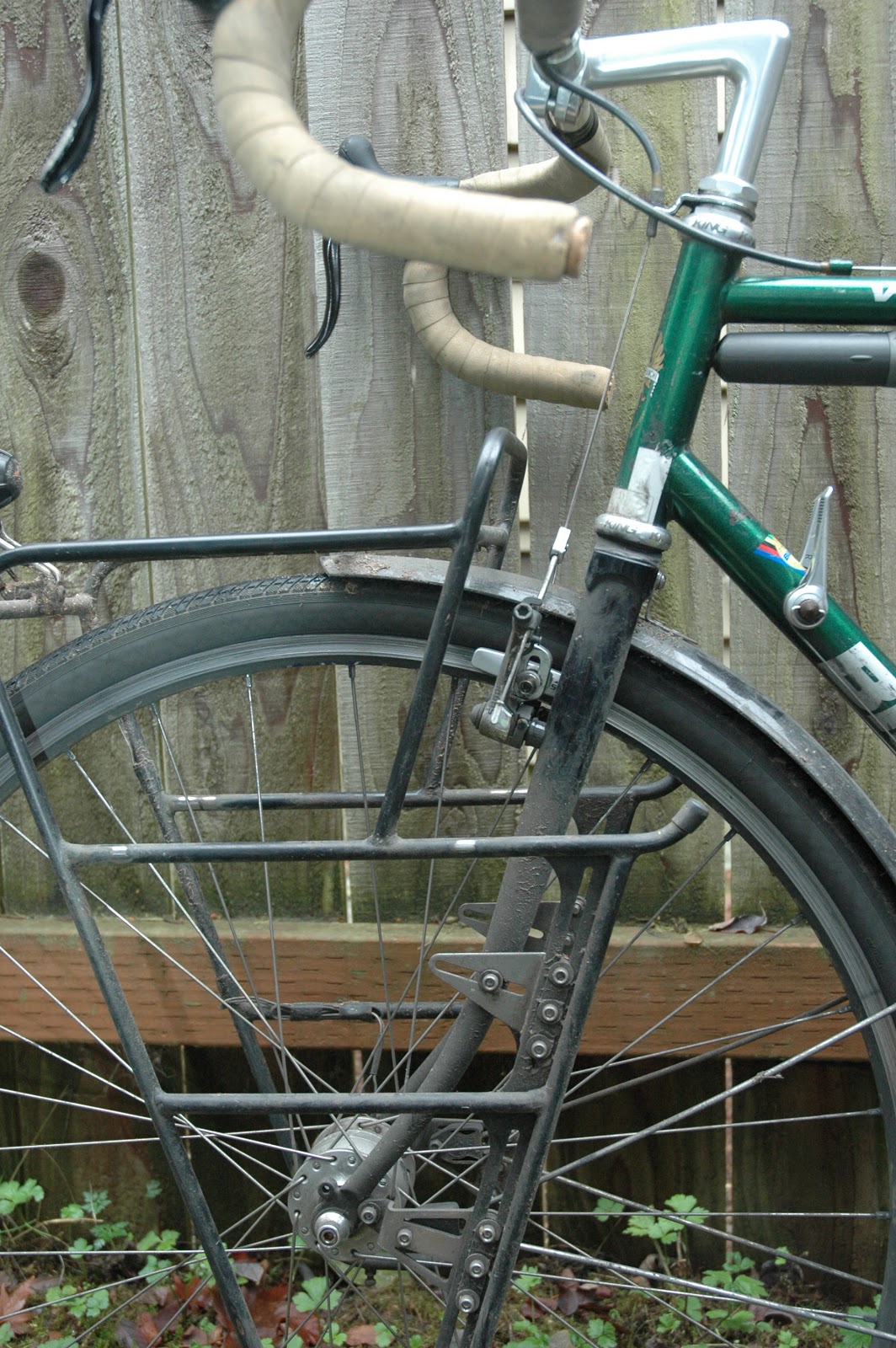
Frictional qualities between the rim and brake pad can also cause squeal and shudder. A new rim can be quite grabby at first, until the surface gets worn in a little. Tubular glue on the rim surface can cause squealing. The brake pad material can make a big difference. In my experience, salmon brake pads squeal less, brake much better in wet conditions, and don't wear the rims out quite as fast as black compounds. Sometimes taking a brillo pad or sandpaper to the rim and brake pad can eliminate squealing. In this case the brake pads were getting thin so I replaced them (Yokozuna salmon pads) and the problem is solved.
Finally, its possible that laxity where the brake pivots on the cantilever post or in the parallelogram linkage on V brakes may facilitate squealing.
The amount of fore/aft movement of the fork under braking influences shudder and squeal, as described above. A properly designed fork can help eliminate the shudder. Modern cyclocross carbon forks have gone to truly massive fork crowns and oversize lower headset bearings to minimize flex between the cantilever posts and cable stop. It seems to me that a fork crown mounted cable stop is an easier, lighter, and more elegant solution. For a steel fork- the fork blades should be oval in cross section at the crown and taper down below the cantilever posts to a nice small radius bend near the dropouts. This makes it so that fore/aft flexion occurs mostly below the cantilever posts where it won't create the bow string effect. This also makes it so that more up/down flexing occurs over bumpy terrain, improving ride quality. The current trend of making straight-bladed steel forks bugs me! Its done either to mimic carbon forks or save labor, but there is no functional reason for it that I am aware of.
A word on discs, because I know what you're all thinking... I know, hydraulic discs are awesome. I have used them. They belong on suspension bikes because they have unsurpassed power and modulation. I don't have my own yet but someday I will. Hydraulic discs are overkill on a road racing bike or cyclocross racing bike. But on a cargo, commuter, or mountain bike its probably worth the added weight and complexity for the truly awesome braking power. Going down a steep hill in a rainstorm with a trailer? I've done that many times, and you have to be really careful!
I'm not sold on cable actuated disc brakes. They have the same drawbacks as hydraulic discs in terms of weight and complexity but aren't as powerful because of cable flex. The pads have to sit really close to the rotor so they are more prone to brake rub if the rotors are warped. Cantilevers are maligned as much as they are because of tricky setup. A properly set up cantilever is just as powerful, or nearly so, compared to a cable disc. A poorly set up cantilever is admittedly awful. No power, poor modulation, and noisy. The most common pitfalls are a straddle cable that is too high, resulting in no power, or crappy pads. I don't even bother with the stock black pads anymore. They are immediately replaced with salmon pads.
So before you toss your cantilevers in the garbage, tinker with them a little. Lower the straddle cable and change the pads. You might be surprised.
Monday, November 12, 2012
Tyler Farrar races cyclocross
Its not every day a punter like me gets to line up next to Tyler Farrar. Before the gun went off I told him I remembered when he showed up at South Seatac back when he rode for Cofidis. Now he is a grand tour stage winner and he still shows up to the local cyclocross race! I think that demonstrates a real love for the sport. He kept telling people taking his picture before the race that he isn't good at this. Yeah well with legs like that you can't go too wrong. I've seen legs like that before- on a quarter horse.
Tuesday, September 25, 2012
what is your bike made out of?

This one is made of steel. On my home home from work I made a bonehead move- a left hand turn into an oncoming car. No idea why I didn't see it. I've been riding to and from work most days for 10 years. I hit the front of the car at an angle, went over the bars, bounced off the windshield and landed on my feet. I completely caved in the windshield and don't even have a bruise myself. Really stupid and really lucky. The visibly shaken but nice woman in the car that I hit and I had a short but pleasant conversation and exchanged information. I put the wheel back in the skewed fork and rode home, slowly.
Try that with a carbon fork. I'm afraid the fork is beyond help this time but I had the people at Elliott Bay straighten it from a crash several years ago. Right now there is a trend for even steel frames to use a carbon fork. I would rather ride a carbon frame with a steel fork. A frame is a nice strong triangle and less likely to fail, and even if it does you can probably land safely. If, on the other hand, a steerer tube or fork leg snaps while you are riding- and we all know that it happens- you are going to hit the ground hard.
Other benefits of a properly designed steel fork, aside from reliability, in my opinion, are better ride quality and better clearance for mud/fenders/bigger tires. Its probably true that carbon transmits less road vibration and has a nice damp feel to it. The straight legs on carbon forks are really stiff vertically. A steel fork with the offset in a nice round bend near the dropouts, like this Colorado II fork, is much more comfortable. If anyone has an orphaned Serotta Colorado fork with 9 inches of steerer let me know!

Sunday, September 16, 2012
Steilacoom
After riding towards the front of the Cat 3 field for the last 5 years, I finally got a win today. Usually I'm content to just race but I really wanted a win at Steilacoom. My first cross race was at Steilacoom in 2005, with no spandex and on my trusty Bontrager hardtail. I had just read an article in the Seattle Times about cyclocross. I didn't know anyone who raced cyclocross but I had to try it. Steilacoom, even without the legendary Knapp time run up, is one of my favorite courses- along with Woodland Park and the old Fort Flagler. Now its on to Cat 2 pack fodder. Its been fun.
I'm normally not one to geek out on gear. I have no idea what is taking Don Walker so long to build my new cross bike. I'm still racing on a generic aluminum frame with barcon shifters I built up in 2006. But today I had on a new set of Challenge Fango clinchers. I have used a Challenge tubular on the front before but I never got around to building up a tubular rear wheel because I rolled the front tire off once or twice. You can't have a decent result if you roll your tire. So I usually just use a clincher with WTB cross wolf tires. They do corner really well. But I've got to think that a handmade tire with a really supple casing has noticeably improved rolling resistance. I think its true that a tubular is faster if you can get it to stay on, because you can run them at lower pressures and therefore have better traction in corners. They are also lighter but I think the weight is a non issue. But I suspect a handmade clincher with a cotton or cotton/poly casing has the benefit of extremely low rolling resistance, similar to a handmade tubular tire. The Biccyle Quarterly people have done some really interesting tests on rolling resistance that seem to bear this out. Its really kind of funny that with all the carbon wheels, electronic shifting, and other high zoot items that seem to be must-have items for a lot of people- the single best thing you can do to make yourself faster, with respect to equipment, is buy some old fashioned handmade tires. One nice thing about that- we are talking about 80 dollars instead of 40 dollars for a tire. Not thousands for carbon wheels or electronic drivetrains.
It must have been close to 80 degrees at Steilacoom today. I'm hoping the odd color of my urine is from beet salad and not dehydration. It was dry and dusty, but a lot of the corners were still tricky due to loose dirt/sand/gravel. My plan was to not eat it too hard in any of the turns and pick people off going up the long hills and it worked. One of the dudes in the creepy pink kit with kittens and knives on it was killing it on a singlespeed- I would have been in trouble if he had been riding a geared bike. A Keller Rohrbach rider was close too but I think I heard him slide out at one point and he couldn't make it back.
I'm normally not one to geek out on gear. I have no idea what is taking Don Walker so long to build my new cross bike. I'm still racing on a generic aluminum frame with barcon shifters I built up in 2006. But today I had on a new set of Challenge Fango clinchers. I have used a Challenge tubular on the front before but I never got around to building up a tubular rear wheel because I rolled the front tire off once or twice. You can't have a decent result if you roll your tire. So I usually just use a clincher with WTB cross wolf tires. They do corner really well. But I've got to think that a handmade tire with a really supple casing has noticeably improved rolling resistance. I think its true that a tubular is faster if you can get it to stay on, because you can run them at lower pressures and therefore have better traction in corners. They are also lighter but I think the weight is a non issue. But I suspect a handmade clincher with a cotton or cotton/poly casing has the benefit of extremely low rolling resistance, similar to a handmade tubular tire. The Biccyle Quarterly people have done some really interesting tests on rolling resistance that seem to bear this out. Its really kind of funny that with all the carbon wheels, electronic shifting, and other high zoot items that seem to be must-have items for a lot of people- the single best thing you can do to make yourself faster, with respect to equipment, is buy some old fashioned handmade tires. One nice thing about that- we are talking about 80 dollars instead of 40 dollars for a tire. Not thousands for carbon wheels or electronic drivetrains.
It must have been close to 80 degrees at Steilacoom today. I'm hoping the odd color of my urine is from beet salad and not dehydration. It was dry and dusty, but a lot of the corners were still tricky due to loose dirt/sand/gravel. My plan was to not eat it too hard in any of the turns and pick people off going up the long hills and it worked. One of the dudes in the creepy pink kit with kittens and knives on it was killing it on a singlespeed- I would have been in trouble if he had been riding a geared bike. A Keller Rohrbach rider was close too but I think I heard him slide out at one point and he couldn't make it back.
Thursday, August 23, 2012
running stairs
Cyclocross season is almost here- I suspect most people have some sights, sounds, or habits that are the harbinger of fall. Maybe its the chill in the air in the mornings or the leaves starting to turn color. One thing for me is running stairs. Usually the ones overgrown with blackberries and ivy off of 98th street, because they're close to home. It is a sure fire way to get in a maximum intensity interval workout and wake up the running muscles that occasionally are called into use in a cyclocross race.
I started running stairs before I started racing cyclocross. I worked for a guy in the veterinary school in Pullman in the summer, making anatomy specimens. I had heard he was a helicopter machine gunner in the Vietnam war. He had an odd, quiet intensity about him. He always won his age division in running events in the area and had a tendency to quench his post race thirst with beer. If you worked for him, there was a deal that on tuesdays you could exercise for an hour or two on the clock. But you had to exercise- if you were eating, reading, or on the computer you had to clock out. I'm sure it was a flagrant violation of university policy but nobody ever questioned what this guy did. So we would run stairs at the stadium on the clock. We usually had to climb a chain link fence to get into the stadium but nobody ever seemed to care. When I moved back to Seattle after graduation, I was irked that it was not possible to get into the UW stadium to run stairs. If I ever own my own business I am going to continue the tradition of physical fitness tuesdays.
I started running stairs before I started racing cyclocross. I worked for a guy in the veterinary school in Pullman in the summer, making anatomy specimens. I had heard he was a helicopter machine gunner in the Vietnam war. He had an odd, quiet intensity about him. He always won his age division in running events in the area and had a tendency to quench his post race thirst with beer. If you worked for him, there was a deal that on tuesdays you could exercise for an hour or two on the clock. But you had to exercise- if you were eating, reading, or on the computer you had to clock out. I'm sure it was a flagrant violation of university policy but nobody ever questioned what this guy did. So we would run stairs at the stadium on the clock. We usually had to climb a chain link fence to get into the stadium but nobody ever seemed to care. When I moved back to Seattle after graduation, I was irked that it was not possible to get into the UW stadium to run stairs. If I ever own my own business I am going to continue the tradition of physical fitness tuesdays.
Subscribe to:
Posts (Atom)


